The Ghana Premier League Through the 4Ps · Part 3
THE GHANA PREMIER LEAGUE THROUGH THE 4Ps: PLACE
If the product is the experience and price determines its perceived value, place determines whether people can actually access it.
When we talk about “Place” in marketing, the conversation is often reduced to location. Where is the product sold? Where can the customer find it? Where does the transaction happen? While these questions remain relevant, that understanding of Place is no longer sufficient for a modern consumer market. Place is fundamentally about access, distribution, availability, convenience and the environments through which consumers encounter, experience and consume a product.
That is why Place becomes particularly interesting when we examine the Ghana Premier League.
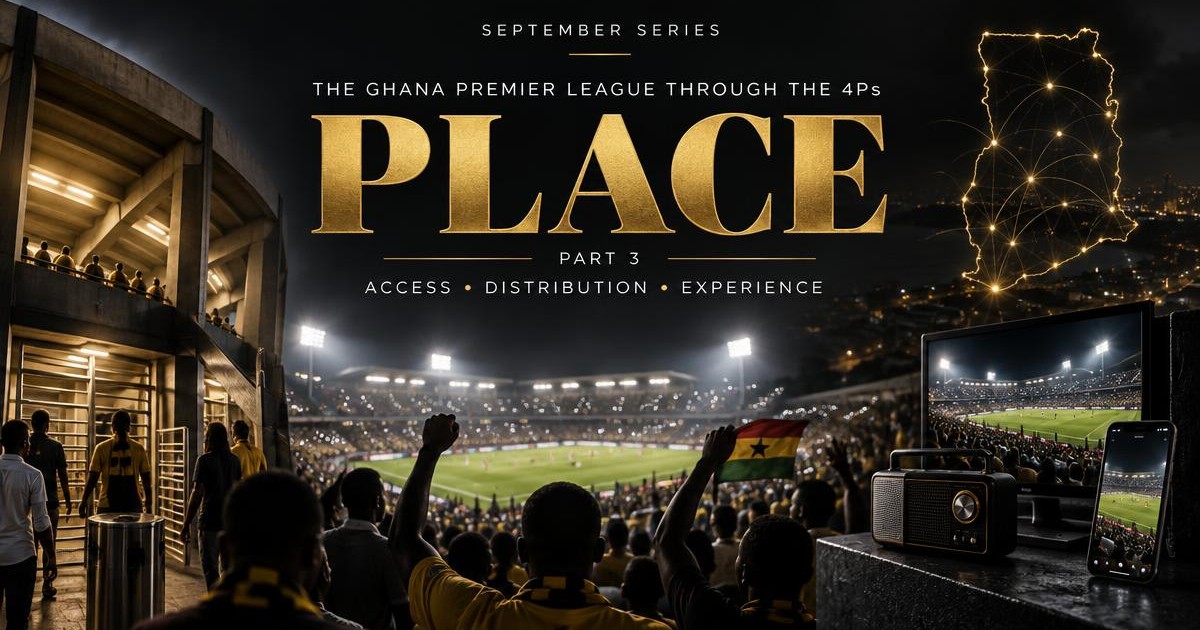
The Ghana Premier League is not simply a competition played inside football stadiums. It is a national entertainment product that is distributed through physical venues, television, radio, streaming platforms, social media and mobile devices. It is experienced by the supporter sitting in the stands, the family watching from home, the commuter listening to commentary in a car, the young fan following highlights on a smartphone and the Ghanaian living abroad who may never have entered a Ghanaian stadium but still follows the league digitally.
So, as I continue my September examination of the Ghana Premier League through the traditional marketing mix of Product, Price, Place and Promotion, the question today is not simply, “Where is the Ghana Premier League played?” The more important question is, where, how and under what conditions can the Ghana Premier League be experienced by its customers?
That distinction matters because a product can be excellent, competitively priced and professionally packaged, but if consumers cannot conveniently access it, the marketing system remains incomplete.
The Ghana Premier League already possesses an extraordinary geographical advantage. The 2026/27 season features 18 clubs spread across nine league centres, with 14 venues approved for the campaign. Those venues stretch across football communities including Tamale, Accra, Kumasi, Tarkwa, Bibiani, Samreboi, Bechem, Berekum, Kukurantumi and Obuasi. The current season officially began over the September 4 to 7 weekend, with the GFA deliberately maintaining a predominantly weekend schedule as part of its effort to maximise fan engagement and stadium attendance.
From a marketing perspective, this is significant because the Premier League does not have to manufacture geographic relevance. It already exists.
There is football in Accra. There is football in Kumasi. There is football in Tarkwa. There is football in Bibiani, Bechem, Berekum, Samreboi, Kpando, Kukurantumi, Obuasi and several other communities. Every one of these locations represents more than a venue. Each represents a community, a supporter base, a local economy, a cultural identity, a potential commercial audience and an opportunity for brands to connect with consumers.
In other words, the geographical footprint of the Ghana Premier League is already a distribution network.
The challenge is whether we are using that network effectively.
This is where I believe our thinking about Place needs to change. We should stop looking at the geographical spread of the Ghana Premier League simply as a consequence of where clubs happen to be located and start looking at it as one of the league's strongest commercial assets. The league has eighteen clubs, hundreds of players, multiple football regions, established rivalries, thousands of supporters and a continuous supply of stories. It has a physical presence that many entertainment brands would struggle to build from scratch.
The question, therefore, should no longer be simply how we get football into these communities. The question should be how we use these communities to make the Ghana Premier League more valuable.
That begins with the stadium.
The stadium remains the most important physical point of consumption for the league. It is where supporters experience the emotion of the game, where rivalries become tangible and where the relationship between club and supporter becomes physical rather than merely digital. But having a stadium is not the same thing as having a compelling matchday experience.
Every club has a home, but does every club have a home experience?
There is a difference.
A home ground should be the physical expression of a club's identity. When a supporter arrives, they should immediately know whose home they have entered. The branding should be visible, the atmosphere should be distinctive, merchandise should be accessible, sponsors should have meaningful activations, food and beverages should be available, security should inspire confidence and the entire environment should communicate that attending a Ghana Premier League match is an experience worth leaving home for.
This is particularly important because the consumer's journey does not begin when they enter the stadium. It begins much earlier.
The supporter has to decide whether to attend. They have to consider transportation, distance, time, cost, parking, safety, ticket availability and the overall convenience of the journey. After arriving, they consider queues, entry procedures, seating, sanitation, food, security and the atmosphere. After the match, they consider how easily they can return home. All of these factors influence their perception of the product.
This is why Place cannot be separated from the broader customer experience.
A stadium may be approved and technically fit to host a match, but that does not automatically make it commercially effective. From a marketing perspective, the real question is whether the venue makes consumption easy, convenient, safe and desirable.
And this is where the Ghana Premier League faces one of its most interesting challenges.
The league is no longer competing only against other stadiums. It is competing against the living room.
The modern football supporter has alternatives. They can stay home and watch European football. They can consume highlights on social media. They can watch a Ghana Premier League match on television or streaming platforms. They can listen to commentary on radio while doing something else. They can spend their afternoon at a restaurant, an event or with family.
The stadium therefore has to provide something the screen cannot fully replicate.
It must provide atmosphere, community, belonging, social interaction and the feeling of being part of something. The supporter should feel that being physically present offers an experience that cannot simply be reproduced by watching the same match from a sofa.
This becomes even more important as the distribution of the Ghana Premier League continues to expand beyond the stadium.
The GFA reported that during the 2025/26 season, 186 Ghana Premier League matches were produced and broadcast, including 75 live broadcasts and 111 non-live telecasts, alongside extensive online streaming. The Association has also been expanding radio distribution, with 78 accredited radio stations across the country signed up to rebroadcast live Ghana Premier League commentary during the 2025/26 season.
That is a major development from a Place perspective because it means the Ghana Premier League is no longer dependent on physical attendance to distribute its product.
The product can enter a person's home through television. It can enter their car through radio. It can enter their pocket through a smartphone. It can appear in their social media feed through short-form content. It can become part of a conversation on WhatsApp. It can be consumed by someone sitting hundreds or thousands of kilometres away from the stadium.
That is distribution.
And digital distribution should not be seen as a threat to physical attendance. If managed properly, it should actually strengthen it.
Imagine a supporter discovering a club through a TikTok video, following the club on Instagram, watching a match online, becoming interested in the players and then receiving information about the next home fixture. They buy a ticket, travel to the stadium, experience the atmosphere, purchase a jersey, take photographs, share their experience online and subsequently become part of the club's digital community.
That is what an effective Place strategy looks like.
Digital should feed the stadium, and the stadium should feed digital.
The two should not operate as competing channels. They should operate as interconnected parts of the same customer journey.
This is also why the fixture calendar itself should be regarded as a marketing decision. Where a match is played matters, but when it is played matters as well. The GFA has indicated that the 2026/27 calendar is structured predominantly around weekends, with no official midweek fixtures, partly to reduce travel demands on clubs and improve player welfare while supporting fan engagement.
That is not simply an administrative decision. It is a customer-access decision.
A supporter who works Monday to Friday may find a Saturday fixture significantly easier to attend than a Wednesday afternoon match. A family may be more willing to attend a weekend fixture. A strategically selected evening kick-off may create a different atmosphere and consumption pattern from an afternoon game.
This means scheduling, stadium availability, broadcasting and ticketing cannot be treated as isolated operational matters. They are all components of the Place strategy.
The GFA itself appears to recognise this connection. In its engagement with all 18 Premier League clubs ahead of the 2026/27 season, discussions covered match scheduling, stadium availability, kick-off times, television production and broadcasting, matchday experience, ticketing, security, officiating, integrity, publicity and promotion. The Association also emphasised affordable and innovative ticketing models as part of efforts to improve fan attendance.
That is the right direction because accessibility must eventually become something we measure.
How many supporters live within reasonable travelling distance of a stadium? How many actually attend? How long does the average supporter spend travelling to the venue? How much does that journey cost? How many tickets are purchased digitally? How many supporters consume matches through television, streaming or radio? Which venues consistently attract stronger attendance? Which fixtures attract supporters who travel from other regions? How much economic activity does a major fixture generate around a stadium?
These are not simply football questions.
They are marketing intelligence questions.
And once we begin asking them, another opportunity becomes visible: tourism.
The geographic spread of the Ghana Premier League creates an opportunity for football to become part of Ghana's broader domestic tourism economy. A major football fixture can move people from one part of the country to another, and when people move, they spend money on transportation, accommodation, food, entertainment, merchandise and other local services.
Imagine a supporter travelling from Accra to Kumasi for a major fixture. Imagine another travelling to Tarkwa for a Medeama match, or a football enthusiast visiting Berekum during a major derby weekend. Imagine international Ghanaian football supporters planning trips around significant domestic fixtures because the experience has been packaged as part of a broader Ghanaian football and cultural journey.
Football can move people.
And movement creates economic activity.
This is where the Ghana Premier League could begin to think beyond the match itself. A fixture should not simply be an event that takes place inside a stadium. It can become a reason to travel, a reason to stay overnight, a reason to eat locally, a reason to visit a community and a reason to experience something beyond the 90 minutes.
That would require collaboration between clubs, the GFA, tourism authorities, hotels, restaurants, transport companies, travel businesses, local authorities and sponsors. But the opportunity is there.
The same thinking can be applied to away matches.
We tend to describe an away fixture simply as a sporting obligation. From a marketing perspective, however, an away match represents movement. When a major club travels to another football community, it brings supporters, media attention, commercial interest and storytelling opportunities with it.
An away fixture can therefore become a mobile commercial event.
If Asante Kotoko travels to Berekum, Hearts of Oak travels to Bibiani, Medeama travels to Samreboi or another major club travels to a smaller football community, the economic and media activity around that fixture can change the dynamics of the host location.
The league is not merely moving players from one stadium to another.
It is moving audiences, attention, media value and potential economic activity.
That is Place.
Of course, none of this works without investment. There are encouraging developments in that regard. The GFA has announced GH¢1 million in financial support for each of the 18 Premier League clubs ahead of the 2026/27 season, describing the intervention as part of a broader effort to strengthen the financial foundations of domestic football and create conditions for sustainable growth and competitiveness.
The important question now is what this investment ultimately produces for the customer.
If stronger finances lead to better facilities, better matchday operations, stronger digital infrastructure, better content production, improved supporter services and more professional club administration, then the investment begins to translate into a stronger Place proposition.
But if money enters the system without meaningfully improving the customer journey, then we have strengthened the inputs without sufficiently strengthening the experience.
This is why I believe the future of Place in Ghanaian football is omnichannel.
The future should not be stadium versus television. It should be stadium plus television plus radio plus streaming plus social media plus mobile plus community.
A supporter should be able to discover a club digitally, follow its story, purchase a ticket, travel to the stadium, experience the match, buy merchandise, share content, watch highlights afterwards and remain connected to the club throughout the week. Every one of those touchpoints is part of the Place strategy.
That is the opportunity before the Ghana Premier League.
We already have the geographical footprint. We already have the communities. We already have the stadiums. We already have the rivalries. We already have the supporters. We already have growing broadcast and digital infrastructure. What we need now is the commercial imagination to connect these assets into one coherent distribution system.
If we get Place right, the Ghana Premier League can become more than a competition that happens to be played across Ghana. It can become a national football distribution network, connecting clubs to communities, communities to supporters, supporters to brands, brands to consumers, stadiums to tourism, football to media and digital audiences back to physical experiences.
That is the ecosystem we should be building.
The Ghana Premier League does not have a problem of having nowhere to go. It has the opposite problem.
It has many places to go, but we have not yet fully commercialised the journey.
And that is why Place matters.
Product asks what we are offering. Price asks what the consumer believes that offering is worth. Place asks whether the consumer can actually access and experience it.
A brilliant product that people cannot conveniently access will struggle. A valuable product that is difficult to consume will lose customers. A national product that does not distribute itself effectively will remain smaller than its potential.
The Ghana Premier League therefore needs to think beyond where its matches are played. It needs to think about where its supporters are, where its potential supporters are, where its sponsors want to reach, where its content can travel, where its commercial opportunities exist and how these different points can be connected.
The stadium is only the beginning.
The television screen is another venue. The radio is another venue. The smartphone is another venue. Social media is another venue. The community is another venue. And increasingly, the world is another venue.
Place is not simply where Ghana Premier League football happens. Place is how Ghana Premier League football reaches people.
When we finally understand that, we will begin to see the Ghana Premier League not merely as a competition played across a collection of approved venues, but as a national entertainment brand capable of travelling far beyond every one of them.
And perhaps that is the real opportunity in front of Ghanaian football: not simply to make people come to the game, but to make the game capable of going to the people.
Product. Price. Place.
Two have already been examined.
Now we have arrived at the third.
Next: Promotion.
Because even the strongest product, appropriately priced and effectively distributed, still has to earn attention. And that is where the final P forces us to confront one of the most important questions in Ghanaian football:
Are we actually marketing the Ghana Premier League, or are we simply announcing that football matches are taking place?