The Ghana Premier League Through the 4Ps · Part 1
The Ghana Premier League Through the 4Ps: PRODUCT
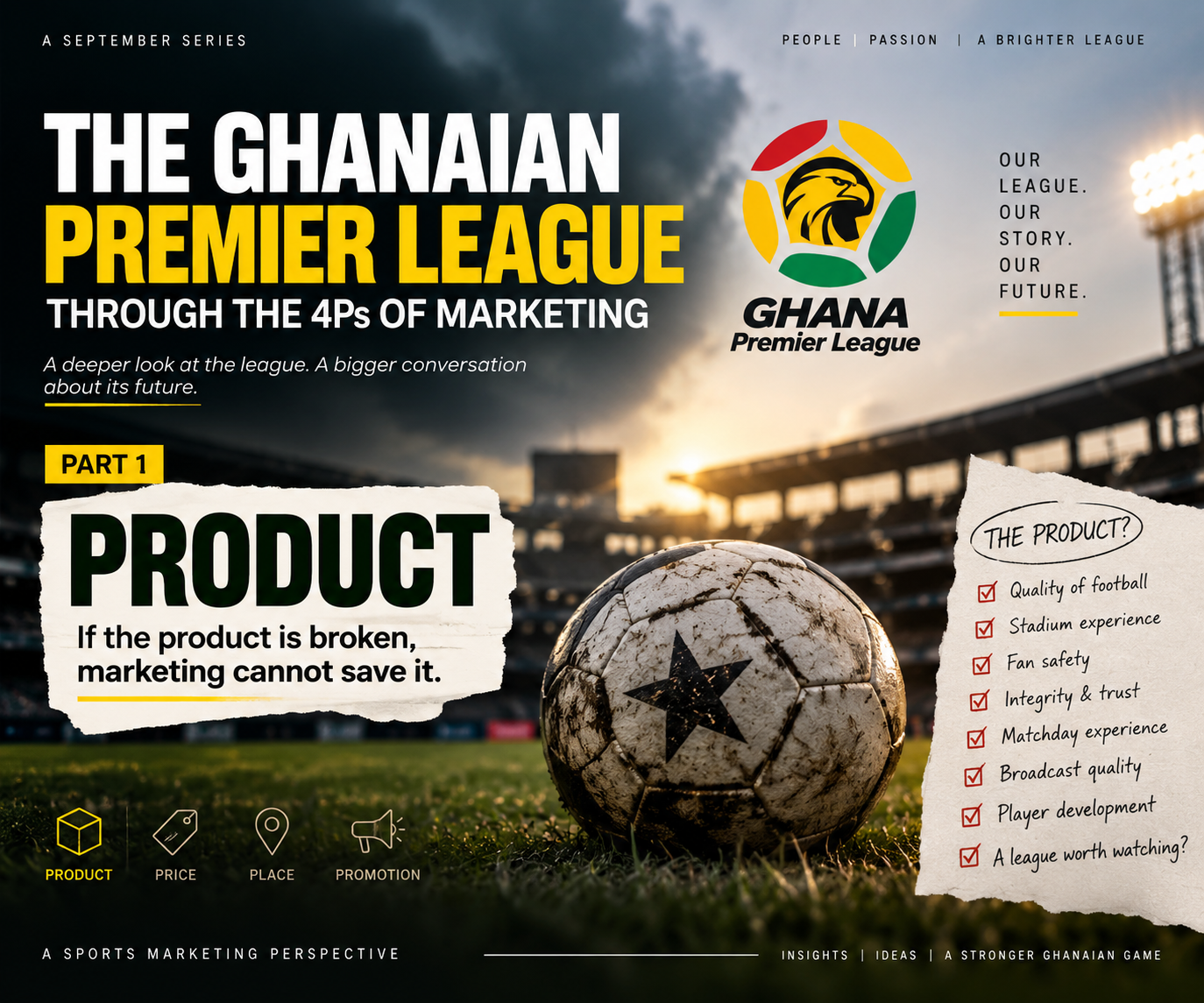
If the product is broken, marketing cannot save it.
Two weeks ago, I wrote about the Ghana Premier League as a brand and why I believe we need to stop looking at it simply as a football competition and start treating it as a commercial and entertainment product.
For the month of September, I want to take that conversation further by looking at the league through one of the most basic frameworks in marketing: the 4Ps; Product, Price, Place and Promotion.
And naturally, we begin with Product.
Because before we ask how to promote the Ghana Premier League, how to attract sponsors, how to increase social media engagement or how to get more people into stadiums, there is a more fundamental question we need to answer:
What exactly are we selling?
The Ghana Premier League is a product.
It is 18 clubs, hundreds of players, matches, rivalries, stadiums, supporters, broadcast content, personalities, stories and experiences brought together under one competition. And like every other product, consumers ultimately judge it by the experience it delivers.
This is where the conversation becomes uncomfortable.
Ghana has never lacked football talent. We have never lacked football history. We have never lacked passionate supporters. We have rivalries, legendary clubs, iconic players and stories that could fill documentaries.
Yet, the Ghana Premier League continues to struggle with some of the basic elements that make a sports product attractive.
We hear complaints about poor pitches and stadium infrastructure. We hear concerns about officiating. We have had disturbing conversations around supporter violence and safety. We have heard allegations and concerns about betting and match manipulation. We have seen questions about governance, scheduling, broadcast quality and the overall matchday experience.
These aren't simply football problems.
They are product problems.
Take the issue of playing surfaces. Concerns about the condition of pitches have repeatedly surfaced, with stakeholders arguing that poor playing surfaces affect the quality of football and the ability of teams and players to perform at the required level.
Now look at that through a marketer's eyes.
If the physical environment in which the product is consumed consistently compromises the product itself, you have a problem that no advertising campaign can permanently solve.
Imagine buying a premium phone and receiving it in damaged packaging. Imagine paying for a five-star hotel and discovering that the room is poorly maintained. Imagine going to a restaurant where the food is good but the environment is consistently uncomfortable.
You wouldn't simply say, “At least they advertised well.”
You would question the product.
Football should be no different.
Then there is the issue of trust.
Ghanaian football has had persistent conversations around betting and match manipulation. The GFA has itself acknowledged the threat that unauthorised betting and match manipulation pose to the integrity and reputation of the game, and has introduced integrity training and other measures to address the issue.
More recently, former GFA vice-president George Afriyie argued that concerns about the credibility of the Ghana Premier League are making it difficult to attract major sponsors, pointing specifically to perceptions that matches can be manipulated.
Whether every allegation is true is not the point I am making here.
The point is that perception has commercial consequences.
A company doesn't simply ask, “How many people watch this league?”
It also asks, “What does associating my brand with this league say about me?”
That is why integrity is not merely a governance issue.
Integrity is a branding asset.
A sponsor is buying association as much as it is buying visibility. If the credibility of the property is questioned, the commercial value of that property is inevitably affected.
And then there is something far more fundamental: the safety of the consumer.
The death of Asante Kotoko supporter Francis Yaw Frimpong, popularly known as Nana Pooley, following violence surrounding the club's match against Nsoatreman in February 2025 should have forced every person involved in Ghanaian football to rethink what we mean by the “matchday experience.” The incident led to the postponement of league fixtures and the introduction of enhanced safety and security protocols.
A football supporter is a consumer.
They spend money on transportation. They buy tickets. They buy food. They wear jerseys. They spend their time. They bring their children. They bring their friends.
And in return, they expect an experience.
That experience begins before the referee blows the whistle.
It includes how they travel to the stadium, how they enter, how they are treated, the quality of the facility, the atmosphere, the security, the football itself and how they leave the stadium.
If a supporter cannot confidently say, “I will go to this match and return home safely,” then we have failed at one of the most basic components of product design.
A recent legal warning that delays in the prosecution of the Nana Pooley case could discourage supporters from returning to stadiums makes the commercial implication even clearer.
This is why I don't believe the attendance problem can simply be solved by saying, “Ghanaians don't support local football anymore.”
That is too easy.
We need to ask why.
What experience are we offering them?
Because consumers have alternatives.
The Ghanaian football fan can spend Saturday afternoon at the stadium. But they can also sit at home and watch the Premier League in high-definition, with multiple camera angles, statistics, commentary, analysis, social media content, fantasy football and endless conversation before and after the match.
The competition for the Ghana Premier League isn't only other football.
It is every other form of entertainment competing for the consumer's time and attention.
And this is where the Premier League provides an important lesson.
The Premier League doesn't simply sell 90 minutes of football.
It sells an ecosystem.
The transfer window becomes content. Fixture announcements become content. Press conferences become content. Player personalities become content. Statistics become content. Rivalries become content. Fantasy football becomes content. Post-match analysis becomes content.
The match is the product.
The ecosystem is the experience.
That is why the Premier League can remain relevant even when there is no football being played.
The Ghana Premier League has many of the raw materials required to build something similar.
We have Hearts of Oak.
We have Asante Kotoko.
We have historic rivalries.
We have regional identities.
We have legends.
We have young talent.
We have supporters who can be incredibly passionate.
We have stories.
But having the raw materials isn't the same as packaging them into a compelling product.
And I think this is one of the biggest conversations Ghanaian football needs to have.
We have spent too much time asking how to market the league and not enough time asking how to improve what we are marketing.
The GFA itself has identified several areas requiring improvement, including match scheduling, stadium availability, TV production and broadcasting, matchday experience, ticketing, security, officiating, disciplinary matters, integrity, publicity and promotion.
That list is revealing.
Because it shows that the challenge isn't simply a lack of advertising.
It is an ecosystem challenge.
And there are encouraging signs. The GFA has been engaging clubs on commercialisation and has been working to improve broadcasting and the overall professional management of the competition.
But ultimately, investment must translate into experience.
The question shouldn't simply be whether we have broadcast partners.
It should be whether the broadcast is good enough for someone to choose the GPL over another entertainment option.
It shouldn't simply be whether stadiums are available.
It should be whether people actually want to spend their Saturday there.
It shouldn't simply be whether referees are appointed.
It should be whether supporters believe the competition is fair.
It shouldn't simply be whether sponsors have been secured.
It should be whether the sponsorship creates enough value for companies to want to renew, expand and compete for the property.
And perhaps most importantly, it shouldn't simply be whether we have football fans.
It should be whether we are creating the next generation of Ghana Premier League fans.
That is the real product challenge.
Because a product doesn't remain relevant because of what it was.
It remains relevant because of what it continues to become.
So, no, I wouldn't say the Ghana Premier League is a dead brand.
I would say it is a brand with enormous unrealised equity.
But that equity cannot be unlocked by a new logo, a hashtag or another promotional campaign alone.
We need better pitches.
Better stadium experiences.
Better broadcasting.
Better storytelling.
Better officiating.
Stronger integrity systems.
Better security.
Better fan engagement.
Better player personalities.
Better use of data.
Better commercial thinking.
And above all, consistency.
Because the fundamental principle of marketing remains true:
You can promote a product once. You cannot fake a good experience forever.
The Ghana Premier League doesn't necessarily need to become the English Premier League.
It needs to become the best version of the Ghana Premier League.
And that starts with the Product.